
Sewage Treatment Plants & Septic Tanks
With over 50 years of leading industry experience we can help with the full life cycle of off mains sewage treatment plants and septic tanks from Design to Installation, Servicing and Maintenance.
British Water Accredited Engineers
Wastewater experts since 1973
Work with multiple manufacturers
Many households that are not connected to mains sewers use sewage treatment plants and septic tanks to collect sewage and wastewater. Septic tanks are available in two main types – those with soakaways and those without. Sewage treatment plants work similarly to septic tanks, but they have mechanical components that assist in breaking down solids for more eco-friendly effluent.
We have over 50 years of experience in the Design, Installation, Servicing and Maintenance of off-mains sewage treatment tanks and can assist with the full life cycle of your tank.
Our Services

We design, supply, install and maintain the right sewage treatment plant or septic tank for your needs.
Our work follows the latest Environment Agency, Natural Resources Wales, SEPA, Building Control and Building Standards requirements. We also offer advice and guidance free of charge.

It pays to look after the investment you’ve made in your sewage treatment plant, pump station or even simple septic tank and soakaway.
Our British Water-accredited field engineers are skilled and experienced at solving problems and committed to providing unobtrusive, courteous and effective service, supported by a full-time, office-based Service team, to help you when you need it.
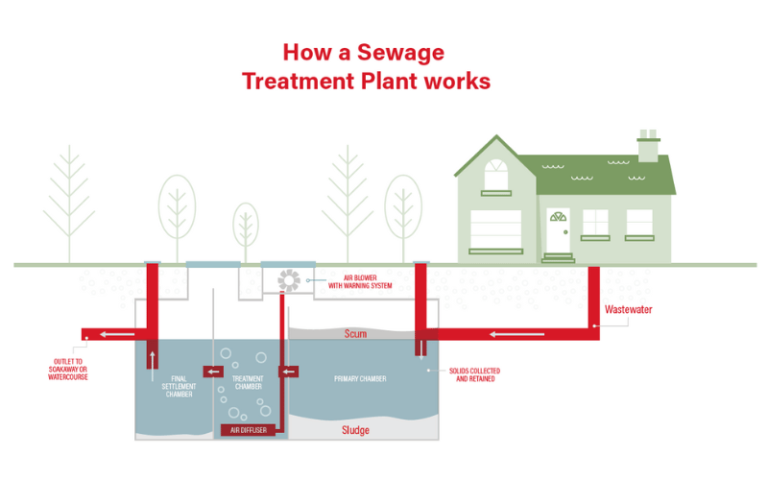
This is how a Sewage Treatment Plant Works
The Sewage Treatment Plant process is similar to the way that a Septic Tank works but mechanical components provide additional processes to help break down solids to produce a cleaner, more environmentally friendly effluent.
Wastewater and sewage are fed into the primary settlement tank where solids and liquids separate and the liquor flows into the biozone chamber. In the chamber, a pump aerates the waste and encourages good bacteria to digest the organic matter, breaking it down and purifying it.
As it leaves the final chamber, known as the humus chamber, the effluent is typically 95% clean and ready for discharge into local watercourses, ditches or land drainage systems, subject to consent by the Environment Agency.
Sewage Treatment Plants need to be emptied at least once a year to keep the system free of the sludge that accumulates naturally over time. Regular servicing is also required to make sure all the components are working at an optimal level.

This is how a Septic Tank Works
Septic tanks are intended to gather sewage and wastewater from homes that are not linked to the mains sewer. There are two primary types of septic tank applications:
Septic Tank with Soakaways
These can be constructed from a variety of materials including brick or concrete. More modern systems are often made from fibreglass or polyethylene.
A septic tank is designed to settle and retain the waste solids produced from a property. This is usually achieved with a number of chambers within the tank and the use of T pipes or baffles. A septic tank should only need emptying when the solids levels have built up within the tank. The settled liquid then drains away through a soakaway or drainage field. The drainage field is designed to treat the waste effluent by the action of naturally occurring bacteria. For this process to work successfully the septic tank must be working efficiently and the subsoil be free draining.
Over time, small particles are carried from the septic tank to the drainage field. The bacteria in the tank create more material, which accumulates in the field and reduces its effectiveness. As a result, the field is less able to release wastewater into the ground at the same rate as it enters the system from the home. Eventually, the drainage field can become clogged, leading to wastewater seeping to the surface or backing up into the house.
The increase in water usage in modern homes, coupled with the use of various chemicals and detergents, can cause issues with the settlement process in septic tanks and the biological processes in drainage fields. These factors, along with changes to environmental and building regulations, may result in areas that were once suitable for septic tank drainage fields becoming non-compliant.
Septic Tank without a Soakaway
If the waste from your septic tank flows directly into surface water such as a stream, pond, river or ditch, it is no longer compliant with the guidelines set by the Environment Agencies. To meet their regulations, you should have replaced or upgraded your treatment system by 1st January 2020. If you sold your property before this date, the replacement or upgrade should have already been done.